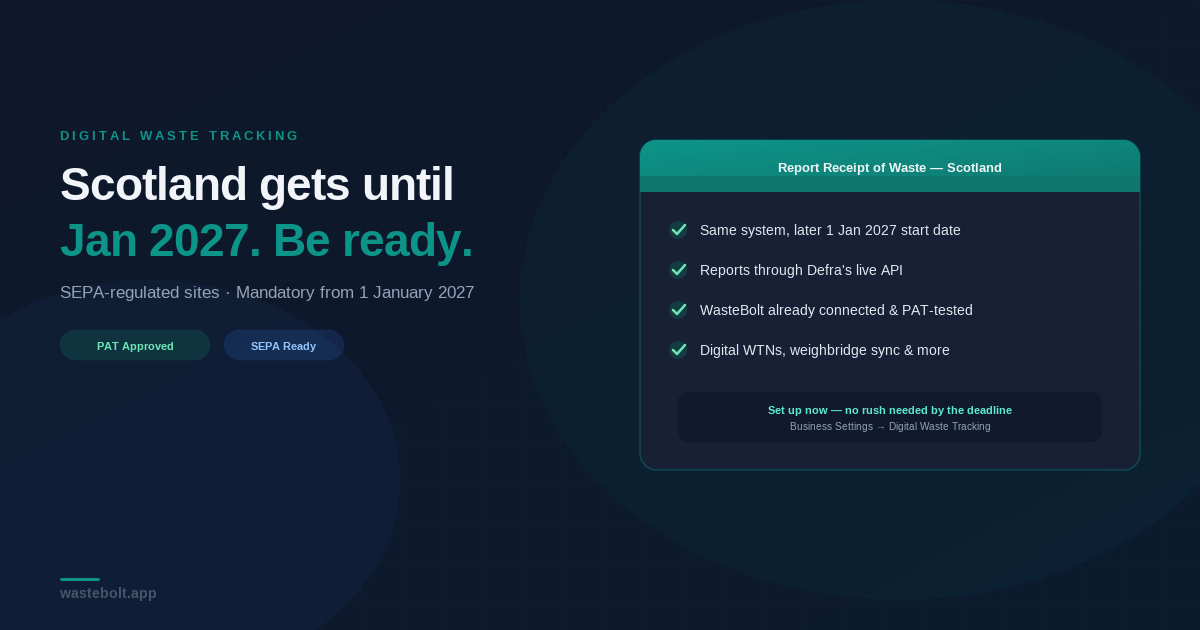
Digital Waste Tracking (DWT) becomes mandatory in Scotland on 1 January 2027. From that date, every permitted site in Scotland that receives controlled waste must record each load it receives on the UK-wide Digital Waste Tracking service, and SEPA will enforce it. This guide covers who is in scope, what you have to report and when, the fee, the penalties, and how to get set up before the deadline.
Digital Waste Tracking in Scotland at a glance
| Scotland | |
|---|---|
| Mandatory from | 1 January 2027 |
| Law | The Digital Waste Tracking (Scotland) Regulations 2026 (SSI 2026/145) |
| Enforced by | SEPA (Scottish Environment Protection Agency) |
| Who is in scope (phase 1) | Permitted facilities that receive controlled waste |
| Deadline per load | By the end of the second working day after the waste is received |
| Corrections | Within one month |
| Annual fee | £26 per year, from when the service becomes mandatory |
| Voluntary use | Open now |
| Phase 2 (carriers, brokers, dealers) | Expected October 2027 |
England and Wales have been under the mandate since 1 October 2026. Northern Ireland also starts in January 2027 — see our Digital Waste Tracking Northern Ireland guide.
What is Digital Waste Tracking?
Digital Waste Tracking is the UK’s digital system for recording waste movements, run by Defra through its Report Receipt of Waste service. Instead of a waste transfer note sitting in a drawer, the receiving site submits the details of each load digitally — what it is, where it came from, who carried it and how much there was.
Scotland uses the same UK-wide service as England, Wales and Northern Ireland. What is different is the law behind it, the start date and the regulator: in Scotland the duty comes from the Scottish regulations, and SEPA monitors compliance.
The law: the Digital Waste Tracking (Scotland) Regulations 2026
The Digital Waste Tracking (Scotland) Regulations 2026 were made by the Scottish Ministers on 11 March 2026, after the draft was approved by the Scottish Parliament. They come into force on 1 January 2027 and cover phase 1 of the rollout: waste received at permitted sites.
The main duties are:
- Record every receipt of controlled waste on the Digital Waste Tracking service.
- Submit it by the end of the second working day after the waste is received.
- Correct mistakes within one month of spotting them.
- Include the consignment note code for hazardous (special) waste.
- Pay the annual service fee of £26.
Is my Scottish site in scope?
According to SEPA’s guidance, phase 1 applies to permitted facilities that receive controlled waste — for example:
- Waste transfer stations
- Scrap metal yards
- Landfill sites
- Energy-from-waste plants
- Composting and anaerobic digestion sites
Not included in phase 1:
- Local authority household waste recycling centre (HWRC) permits
- Former exempt sites now operating under deemed authorisations
- New registration-level authorisations
If you are unsure where your site falls, SEPA’s guidance is the authoritative source, and it is worth checking now rather than in late December.
What if we can’t report digitally?
Sole traders and individuals who genuinely cannot use digital services can apply to SEPA to be treated as digitally excluded. SEPA issues them a number, and they keep written records for three years instead. This does not apply to companies.
What happens if you don’t comply?
The Scottish regulations give SEPA real enforcement powers. It is an offence to fail to record and submit a receipt, or to make a false entry or statement. On conviction, that can mean a fine up to the statutory maximum (summary conviction) or a fine on indictment.
SEPA can also issue:
- Compliance notices, requiring you to put things right
- Enforcement cost recovery notices, to recover its costs
Appeals go to the Scottish Ministers.
Do my existing duties change?
No — not yet. SEPA is clear that the new rules will not immediately remove or change your existing duty of care or waste reporting requirements. You still need compliant waste transfer notes and consignment notes, and you still keep your records. Digital Waste Tracking sits alongside them for now.
That is a good reason to keep your notes and your DWT submissions in the same system, so you are only entering each load once.
What about phase 2?
Phase 2 brings waste carriers, brokers and dealers into Digital Waste Tracking. SEPA says the Scottish phase 2 regulations are under development and expected to come into force in October 2027, with a UK-wide public beta expected in spring 2027.
If you run collection vehicles as well as a receiving site, setting up now for phase 1 means you will already be on the system when phase 2 arrives. See our Digital Waste Tracking phase 2 guide for what we know so far.
How to get set up before 1 January 2027
- Register on GOV.UK. Register your organisation for Report Receipt of Waste using a Government Gateway or GOV.UK One Login account, with the details of each permitted site you operate.
- Get your Defra API code. Defra issues each organisation a unique code once registered.
- Choose how you will submit. Either upload Defra’s spreadsheet template by hand, or use approved software that connects to the service directly.
- Test it now. Voluntary use is already open in Scotland, so you can submit real loads before the deadline and fix any problems while there is no penalty.
Using WasteBolt in Scotland
WasteBolt has passed Defra’s Production Approval Tests and is listed as an approved software provider on GOV.UK. Scottish sites use exactly the same connection as sites in England and Wales — enter your Defra API code in Business Settings and WasteBolt submits each load from the records you already keep:
- Digital waste transfer notes and consignment notes, signed on any device
- Automatic DWT submission, with every record checked against Defra’s codes first
- Weighbridge integration through CSV import or WasteBolt Gatehouse
- Reports and quarterly waste returns from the same data
See the DWT setup guide for a step-by-step walkthrough.
Frequently asked questions
When does Digital Waste Tracking become mandatory in Scotland?
On 1 January 2027, under the Digital Waste Tracking (Scotland) Regulations 2026. England and Wales started on 1 October 2026, and Northern Ireland starts in January 2027.
Is SEPA running its own system?
No. Scotland uses the same UK-wide Digital Waste Tracking service, run by Defra. SEPA is the regulator that monitors compliance and enforces the Scottish regulations.
How long do I have to submit each load?
Until the end of the second working day after the waste is received. Corrections must be made within one month.
How much does Digital Waste Tracking cost in Scotland?
There is an annual service fee of £26, payable from when the service becomes mandatory. Your software may have its own subscription cost on top.
Are exempt sites included?
Not in phase 1. Former exempt sites (now deemed authorisations) and new registration-level authorisations are not included, and nor are local authority HWRC permits.
Can I start using it before January 2027?
Yes. Voluntary use is open now, and starting early is the safest way to make sure everything works before the deadline.
Does Digital Waste Tracking replace waste transfer notes in Scotland?
Not yet. SEPA says existing duty of care and waste reporting requirements are not immediately removed or changed, so you still need your notes.
Sources
- SEPA: Digital waste tracking
- legislation.gov.uk: The Digital Waste Tracking (Scotland) Regulations 2026 (SSI 2026/145)
- GOV.UK: Report Receipt of Waste
- NetRegs: Digital waste tracking
Not sure your site is ready? Take the free DWT Readiness Check or start a 30-day free trial and connect your Defra API code whenever suits you.