If your business produces, carries, or receives hazardous waste, a standard Waste Transfer Note is not enough. This guide explains exactly what a Hazardous Waste Consignment Note is, who needs one, how to complete every section — including HP codes, consignment references, and POPs — and how to go digital.
What is a hazardous waste consignment note?
A Hazardous Waste Consignment Note (HWCN) is the legal document required whenever hazardous waste is transferred between premises in the UK. It replaces the standard Waste Transfer Note for any waste classified as hazardous under the HP code system.
It must be completed before the waste leaves the producer’s site and must travel with the waste to the receiving facility. All three parties — producer, carrier, and consignee — must sign and retain copies.
You cannot use a standard WTN for hazardous waste. Using the wrong document is a criminal offence under the Hazardous Waste (England and Wales) Regulations 2005. The penalty is up to 12 months in prison or an unlimited fine.
WTN vs consignment note — what’s the difference?
Both documents create a chain of custody for waste, but a Hazardous Waste Consignment Note carries significantly more information and stricter legal requirements.
| Standard WTN | Hazardous Consignment Note | |
|---|---|---|
| Waste type | Non-hazardous only | Hazardous only |
| Consignment reference no. | Not required | Mandatory — unique per transfer |
| HP codes | Not required | Mandatory — must select applicable HP1–HP15 |
| POPs declaration | Not required | Required if waste may contain POPs |
| Special handling notes | Optional | Required where applicable |
| RPS number (consignee) | Not required | Mandatory |
| Pre-notification | Not required | Required (England & Wales) |
| Retention period | 2 years (3 in Scotland) | 3 years for all parties |
| Legislation | Environmental Protection Act 1990 | Hazardous Waste Regulations 2005 |
Who needs a hazardous waste consignment note?
Any business that produces, carries, or receives hazardous waste must use a consignment note. This includes:
- Garages and workshops disposing of used oils, brake fluids, or batteries
- Manufacturers disposing of solvents, chemicals, or contaminated materials
- Construction sites removing asbestos, contaminated soil, or treated timber
- Healthcare facilities disposing of clinical or pharmaceutical waste
- Offices disposing of fluorescent tubes, toner cartridges, or electronic equipment (WEEE)
- Farmers disposing of pesticides, herbicides, or sheep dip
- Any business sending waste classified under a hazardous EWC code (marked with *)
Producer registration: In England, Wales, and Scotland, premises producing more than 500kg of hazardous waste per year must register with the Environment Agency (or SEPA / NRW) before consigning hazardous waste. Premises producing less than 500kg are exempt from registration but still need a consignment note for every transfer.
How do I know if my waste is hazardous?
Waste is classified as hazardous if it exhibits one or more of the 15 hazardous properties (HP1–HP15). The starting point is the EWC code — any code marked with an asterisk (*) is absolutely hazardous and requires a consignment note regardless of its actual composition.
Some EWC codes appear in mirror entries — one with an asterisk (hazardous) and one without (non-hazardous). For these, the waste producer must assess the composition to determine which applies.
| Common hazardous waste type | EWC code | Typical HP code |
|---|---|---|
| Used engine oil | 13 02 05* | HP3, HP6 |
| Paint / varnish (solvent-based) | 08 01 11* | HP3, HP4 |
| Fluorescent tubes | 20 01 21* | HP6, HP14 |
| Batteries (lead acid) | 16 06 01* | HP6, HP8 |
| Asbestos | 17 06 01* | HP7, HP9 |
| Clinical / infectious waste | 18 01 03* | HP9 |
| Contaminated soil | 17 05 03* | HP4, HP14 |
| Aerosol cans (containing solvent) | 16 05 04* | HP3 |
Not sure of your EWC code? Search our full EWC code list — all 839 codes with descriptions.
HP codes — the 15 hazardous properties explained
HP codes identify the specific hazardous properties of the waste. A single waste stream can exhibit multiple HP codes — select all that apply. The HP codes must be based on testing, available data, or guidance documentation, and you must record the source of your classification on the consignment note.
| Code | Property | Common examples |
|---|---|---|
| HP1 | Explosive | Ammunition, fireworks, certain propellants |
| HP2 | Oxidising | Peroxides, nitrates, chlorates |
| HP3 | Flammable | Solvents, fuels, paints, aerosols, used oil |
| HP4 | Irritant | Acids, alkalis, cleaning fluids |
| HP5 | Harmful (specific organ toxicity) | Some solvents, pesticide residues |
| HP6 | Toxic | Cyanide compounds, mercury, arsenic |
| HP7 | Carcinogenic | Asbestos, certain solvents (benzene), tar |
| HP8 | Corrosive | Battery acid, strong alkalis, etching fluids |
| HP9 | Infectious | Clinical waste, sharps, laboratory cultures |
| HP10 | Toxic for reproduction | Certain heavy metals, some pesticides |
| HP11 | Mutagenic | Certain chemicals, some pesticides |
| HP12 | Releases acute toxic gas | Waste reacting with water to release toxic gas |
| HP13 | Sensitising | Isocyanates, formaldehyde |
| HP14 | Ecotoxic | PCBs, heavy metals, fluorescent tubes |
| HP15 | Capable of exhibiting hazardous property | Waste that may exhibit hazardous properties after disposal |
Completed consignment note example
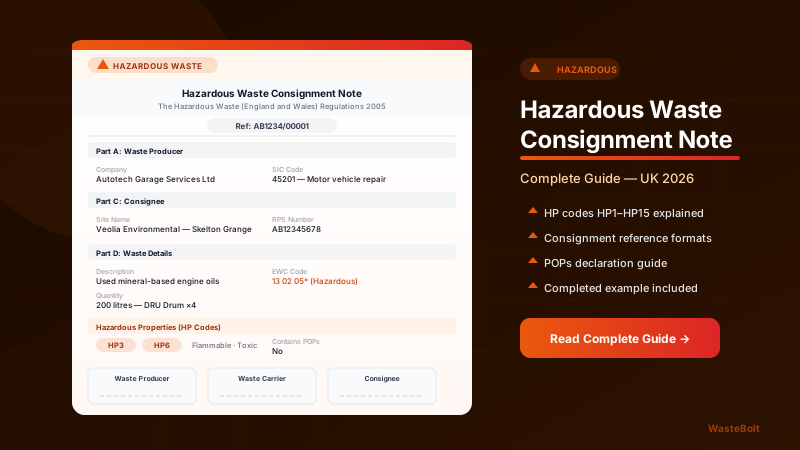
The example below shows a fully completed Hazardous Waste Consignment Note for a garage disposing of used engine oils. The details are fictional but realistic and match the format expected by the Environment Agency.
Consignment reference: AB1234/00001
Part A: Waste Producer Details
- Company name: Autotech Garage Services Ltd
- Address: 22 Mill Lane Industrial Estate, Leeds, LS9 7BG
- SIC code: 45201 — Maintenance and repair of motor vehicles
- Environmental permit: EPR/XP3456LA
- Contact name: Paul Whitfield
- Contact phone: 0113 245 8800
Part B: Waste Carrier Details
- Carrier company: Northern Hazardous Waste Ltd
- Address: Unit 4, Kirklees Business Park, Bradford, BD6 2SZ
- Carrier registration: CBDU987654
- Vehicle registration: BD21 HWC
Part C: Consignee (Receiving Site)
- Site name: Veolia Environmental Services — Skelton Grange
- Address: Skelton Grange Road, Leeds, LS9 9NB
- Environmental permit: EPR/AB1234CD
- RPS number: AB12345678
Part D: Waste Details
- Waste description: Used mineral-based engine oils from vehicle servicing
- EWC code: 13 02 05* — Mineral-based non-chlorinated engine oils (hazardous)
- Quantity: 200 litres
- Containment: DRU — Drum (×4)
- Physical form: Liquid
- Recovery code: R9 — Oil re-refining
Hazardous Properties & Classification
- HP codes: HP3 — Flammable, HP6 — Toxic
- Special handling requirements: Keep away from ignition sources. PPE required: gloves, goggles, chemical-resistant apron.
- Contains POPs: No
- Source of HP classification: Own testing
Part E: Transfer Details
- Transfer date: 3 April 2026
- Transfer location: 22 Mill Lane Industrial Estate, Leeds, LS9 7BG
- Waste hierarchy confirmed: Yes — R9 re-refining selected as best available option
- Pre-notification sent: Yes — confirmed by consignee 1 April 2026
Signatures
All three parties — waste producer, waste carrier, and consignee — must sign, and hazardous waste consignment notes must be retained for 3 years.
Consignment reference numbers by UK region
Every hazardous waste consignment note must carry a unique reference number. The format differs by country.
| Region | Format | Example |
|---|---|---|
| England & Wales | 6-character producer code / 5-digit sequential number | AB1234/00001 |
| Scotland | SA, SB, or SC prefix + at least 7 digits | SA1234567 |
| Northern Ireland | DA, DB, or DC prefix + at least 7 digits | DA1234567 |
Sequential numbering: in England and Wales, the 5-digit number after the slash must increment for each consignment from that producer. Starting at 00001, each new consignment note gets the next number. WasteBolt generates and tracks this automatically.
Persistent Organic Pollutants (POPs)
POPs are chemicals that persist in the environment and accumulate in living organisms. Since January 2021, the UK POPs Regulation requires producers to declare on the consignment note whether the waste contains any regulated POPs components.
If the waste does contain POPs, you must list:
- The name of each POPs component present
- The concentration (in mg/kg) where known
- The source of the information (own testing, guidance, or provided with waste)
Common waste types that may contain POPs include:
- Upholstered furniture manufactured before 2020 (may contain PBDE flame retardants)
- Electrical and electronic equipment (WEEE) from before 2006
- Contaminated soil from former industrial sites
- Certain pesticides and their containers
If you are unsure whether your waste contains POPs, seek a laboratory analysis before completing the consignment note. Disposing of POPs waste incorrectly carries significant penalties.
Pre-notification requirements
In England and Wales, the consignee (receiving facility) must be notified before hazardous waste arrives at their site. This is known as pre-notification and must happen before the waste leaves the producer’s premises.
In practice, the carrier or producer contacts the consignee — usually by phone, email, or through the facility’s own booking system — to confirm:
- The waste type and quantity being sent
- The expected delivery date and time
- The consignment reference number
- Any special handling requirements
Once confirmed, the consignee signs the consignment note on receipt. Pre-notification is not a statutory requirement in Scotland or Northern Ireland, but is considered best practice.
Retention periods for hazardous waste records
| Party | Retention period | What to keep |
|---|---|---|
| Waste producer | 3 years | Signed consignment note + any pre-notification records |
| Waste carrier | 3 years | Signed consignment note for every load carried |
| Consignee (site) | 3 years | Signed consignment note + quarterly returns to EA |
Consignees in England and Wales must also submit quarterly returns to the Environment Agency summarising all hazardous waste received. WasteBolt stores all consignment notes securely in the cloud and makes them instantly retrievable for EA audits.
Digital hazardous waste consignment note software
Digital consignment notes are fully legal under UK waste regulations. WasteBolt’s hazardous waste module handles every element of the HWCN in one form:
- HP code selection — choose all applicable codes from HP1 to HP15 with guided descriptions
- Consignment reference generation — automatic sequential numbering in the correct regional format
- POPs declaration table — add component names, concentrations, and source of information
- Special handling requirements — freetext field carried through to the PDF
- RPS number validation — for the receiving consignee
- E-signatures — all three parties sign digitally, no printing required
- Cloud storage — 3-year retention managed automatically, accessible on any device
- Orange hazardous PDF — generated in the EA-recognised format, ready to share or archive
Frequently Asked Questions
What is a hazardous waste consignment note?
A Hazardous Waste Consignment Note (HWCN) is the legal document required whenever hazardous waste is transferred between premises in the UK. It replaces the standard Waste Transfer Note for any waste classified as hazardous under the HP code system (HP1–HP15).
What is the difference between a WTN and a consignment note?
A standard Waste Transfer Note covers non-hazardous waste. A Hazardous Waste Consignment Note is required for hazardous waste and includes additional mandatory fields: a unique consignment reference number, HP hazard codes, POPs declaration, special handling requirements, and the consignee’s RPS number.
How do I know if my waste is hazardous?
Waste is hazardous if its EWC code is marked with an asterisk (*), or if it exhibits one or more of the HP1–HP15 hazardous properties. Common examples: used engine oils, fluorescent tubes, batteries, solvents, asbestos, and clinical waste.
What is a consignment note reference number?
In England and Wales the format is XXXXXX/YYYYY — a 6-character producer code followed by a 5-digit sequential number (e.g. AB1234/00001). In Scotland: SA/SB/SC + 7 digits. In Northern Ireland: DA/DB/DC + 7 digits.
How long do I keep hazardous waste consignment notes?
Three years minimum for all parties — producer, carrier, and consignee. This is longer than the two-year requirement for standard Waste Transfer Notes.
Do I need to pre-notify the consignee?
Yes, in England and Wales. The receiving facility must be notified before the waste arrives. In Scotland and Northern Ireland pre-notification is best practice but not a statutory requirement.
What’s Next
- How to Write a Waste Transfer Note: Step-by-Step Guide — the non-hazardous equivalent, with field-by-field guidance.
- Waste Transfer Note Template — Completed Example — a fully completed WTN with annotations.
- Hazardous Waste HP Codes Explained — a deeper dive into all 15 hazardous properties.
- Persistent Organic Pollutants (POPs) in UK Waste — what counts as a POP and how to declare it.
- Full EWC Code List — search all 839 codes, with asterisk codes shown clearly.
- Digital Hazardous Waste Consignment Note Software — create digital HWCNs in WasteBolt with HP codes, POPs tables, e-signatures, auto consignment reference, instant PDF and DWT submission built in.