What Is a Hazardous Waste Consignment Note?
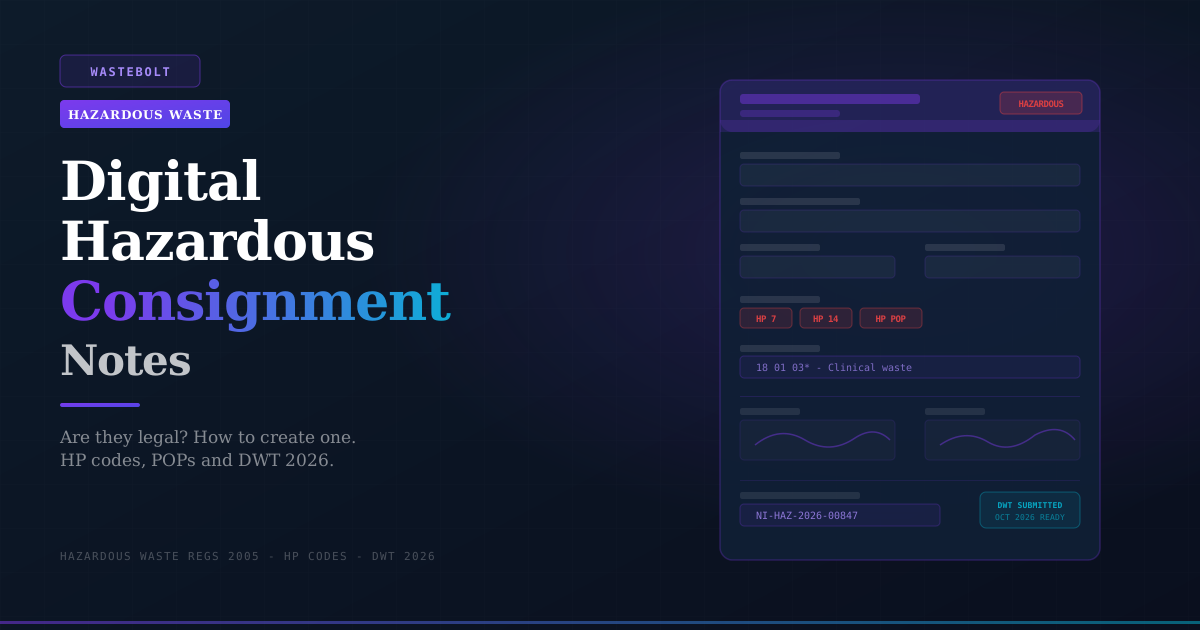
A Hazardous Waste Consignment Note (HWCN) is the legal document required every time hazardous waste is transferred in the UK. It is the hazardous equivalent of a Waste Transfer Note — but with significantly more information required, stricter documentation rules, and heavier penalties for non-compliance.
Where a standard Waste Transfer Note covers non-hazardous controlled waste, a consignment note is required whenever the waste being moved is classified as hazardous under the UK Waste Classification Technical Guidance (WM3). This is identified by an asterisk (*) against the EWC code in the official waste catalogue.
The legal basis is the Hazardous Waste (England and Wales) Regulations 2005, with equivalent regulations applying in Scotland (Special Waste Regulations 1996, as amended) and Northern Ireland.
Are Digital Hazardous Waste Consignment Notes Legally Valid?
Yes — digital consignment notes are fully legally valid in the UK.
The Electronic Communications Act 2000 establishes that electronic documents carry the same legal standing as paper equivalents where they contain the required information. The Electronic Signatures Regulations 2002 confirm that electronic signatures — whether captured on a touchscreen, submitted via a secure link, or confirmed by a click — satisfy the signature requirements on a consignment note.
The Environment Agency has confirmed acceptance of digital consignment notes provided they:
- Contain all the information required by the Hazardous Waste Regulations 2005
- Include valid electronic signatures from all required parties
- Can be produced during inspection or audit within a reasonable timeframe
- Are retained for the required minimum period (3 years for hazardous waste consignment notes — longer than the 2-year requirement for standard WTNs)
The practical advantages of digital over paper are even more pronounced for hazardous waste than for standard WTNs, given the volume of information required and the stricter enforcement regime.
Consignment Note vs Waste Transfer Note — Key Differences
Many waste carriers complete standard WTNs regularly and treat consignment notes as a variation. They are not — a consignment note is a fundamentally different document, with additional mandatory fields (a unique consignment reference, HP codes, a POPs declaration, and pre-notification in some circumstances) and a longer 3-year retention period across all UK nations. For the full field-by-field comparison table, see our complete guide to hazardous waste consignment notes.
What Information Must a Digital Consignment Note Include?
The Hazardous Waste Regulations 2005 prescribe the required content. A legally compliant consignment note must include all of the following.
Part A — Consignment Details
Consignment note code — a unique reference number for the movement. This is distinct from a WTN number. The format is typically assigned by the producer or their software system and must be unique to each consignment.
Date of removal — the actual date the waste leaves the premises of the producer or holder.
Emergency contact — a 24-hour emergency contact number must appear on the consignment note, particularly relevant during transport.
Part B — Producer / Holder Details
Full name and address of the waste producer or holder. For hazardous waste, the producer’s premises address must be stated specifically — not just a company registered address if different.
The producer’s SIC code (Standard Industrial Classification) is required to identify the business activity generating the waste.
Any relevant environmental permit number, exemption, or registered premises number for the producer site.
Part C — Carrier Details
Full name and address of the waste carrier. The carrier’s waste carrier registration number must be stated and must be for a carrier licensed to handle hazardous waste — not all waste carrier registrations cover hazardous material.
Vehicle registration number. Means of transport.
Part D — Waste Description
This is the most detailed section and where digital tools provide the greatest value:
EWC code — the six-digit code from the UK Waste Classification system, with the asterisk (*) confirming hazardous classification. Multiple EWC codes can appear on a single consignment note where the load contains more than one hazardous waste stream.
Physical description — a specific description of the actual waste, not just the EWC category name. “Contaminated soil containing petroleum hydrocarbons” rather than just “soil”.
Physical form — solid, liquid, gas, sludge, powder, mixed.
Quantity — weight in tonnes or kilograms, or volume in litres where appropriate.
HP codes — all applicable Hazardous Property codes must be stated. A waste can exhibit multiple HP properties simultaneously and all must be recorded.
POPs declaration — where the waste contains Persistent Organic Pollutants above the Annex IV threshold concentrations, the specific POPs substances and their concentrations must be declared.
Chemical or biological components — for hazardous waste, the specific hazardous substances present should be identified where known, along with concentration values.
Special handling requirements — any specific requirements for handling the waste safely during transport or at the receiving site.
Part E — Consignee / Receiving Site Details
Full name and address of the site receiving the waste. The consignee’s environmental permit number or waste management licence number allowing them to accept the specific hazardous waste type.
Signatures
Signatures are required from:
- The producer or holder at the point the waste is collected
- The carrier on collection
- The consignee on receipt at the destination
Digitally, these can be captured at point of transfer on a touchscreen device, or sent via a secure signing link to parties who are not present at the time of other signatures.
HP Codes on Consignment Notes — Getting It Right
HP codes are one of the areas where consignment notes most commonly contain errors — usually listing only one HP code when a waste exhibits several, or omitting HP POP where POPs are present above the Annex IV threshold. For the full list of HP1–HP15 properties with examples, and a breakdown of the most common classification errors, see our HP codes and POPs reference.
POPs on Digital Consignment Notes
Persistent Organic Pollutants require a specific declaration on the consignment note wherever they’re present above the Annex IV threshold — the HP POP code, the specific substances (e.g. PCBs, PFOS, lindane), and their concentrations. See our complete guide’s POPs section for what counts as a POP and how to declare it in full.
On the DWT API side specifically, POPs data has its own technical requirements, separate from general hazardous classification — covered in detail below.
The Consignment Note Return Requirement
One of the most commonly overlooked requirements for hazardous waste consignment notes — paper or digital — is the return copy obligation.
Once the consignee (receiving site) has accepted and signed for the hazardous waste, they are required to send a completed copy of the consignment note back to the producer. This must happen within a defined timeframe and confirms that the waste arrived at the correct destination and was accepted.
On paper, this means physically posting or emailing a signed copy back to the producer. On a digital system, this is handled automatically — the consignee signs digitally, the system timestamps the receipt, and a completed copy is distributed to all parties without any manual action.
The return copy is important because it closes the chain of custody. A producer who cannot produce a completed consignment note — including the consignee’s receipt signature — cannot demonstrate that their hazardous waste was properly received. This is a compliance gap that EA inspections regularly identify.
Pre-Notification Requirements
Pre-notification of a hazardous waste movement is required in certain circumstances — mainly in England and Wales, and mostly for specific categories of hazardous waste rather than routine commercial collections. Digital systems can flag pre-notification requirements automatically based on the waste type and movement details, preventing inadvertent non-compliance. For the full rules on when pre-notification applies, see our complete consignment note guide.
How Long Must Digital Consignment Notes Be Kept?
Hazardous waste consignment notes must be retained for 3 years across all UK nations — longer than the 2-year requirement for standard WTNs. Digital notes make this a non-issue: cloud storage is effectively indefinite and costs nothing additional, and notes stay fully searchable and retrievable in seconds for an EA inspection. Best practice is to retain them indefinitely — see our full retention requirements by party for producer, carrier, and consignee obligations.
Digital Consignment Notes and DWT 2026
From October 2026, Digital Waste Tracking becomes mandatory for all permitted waste receiving sites across England and Wales, with Scotland and Northern Ireland following from January 2027. This applies to hazardous waste movements as well as non-hazardous.
The Defra DWT API has specific requirements for hazardous waste submissions:
containsHazardous: truemust be set on the relevant waste items- HP codes must be submitted as structured data fields — not free text
- Where a hazardous consignment note code exists, it must be included in the submission
- POPs data (substance name and concentration) must be submitted separately via the
containsPopsflag andpopsarray — this is a distinct field from the general hazardous classification, and must be explicitly set to true or false for every waste item regardless of whether the waste is otherwise hazardous - Where no consignment note code exists but a reason is provided, this is accepted (tested in PAT scenario H03)
- Where no consignment note code exists and no reason is provided, the submission is rejected as an error (PAT scenario H02)
These two PAT scenarios matter in practice because they determine whether a hazardous movement without a consignment code fails silently or is flagged clearly. Software that mirrors this validation (checking for a code or a stated reason before submission) catches the error before it reaches Defra’s platform, rather than after.
Businesses using digital consignment note software that captures this structured data will be able to submit directly to the DWT platform without re-entering information. Businesses on paper will face manual data entry for every hazardous movement — a significant administrative burden at scale.
How to Create a Digital Hazardous Waste Consignment Note
Wastebolt supports full digital hazardous waste consignment notes, including:
- All required consignment note fields including HP codes, POPs declarations, and consignment note codes
- Digital signature capture at point of transfer on any device
- Automatic PDF generation and distribution to producer, carrier, and consignee
- Return copy workflow — consignee receipt is recorded and distributed automatically
- Cloud storage with 3-year minimum retention and full search capability
- Direct connection to the EA’s DWT platform ahead of the October 2026 mandate
- HP code selection from the full list of 15 classifications
- POPs substance identification from the full regulated list
Start a free trial — no credit card required.
Frequently Asked Questions
Is a digital consignment note legally the same as a paper one? Yes. Digital consignment notes are fully legally valid under the Electronic Communications Act 2000 and Electronic Signatures Regulations 2002, provided they contain all required information and bear valid electronic signatures from all parties.
Can I use the same document for both hazardous and non-hazardous waste in the same load? No. Hazardous and non-hazardous waste must be documented separately. If a vehicle carries both hazardous and non-hazardous waste on the same run, a consignment note is required for the hazardous portion and a separate Waste Transfer Note for the non-hazardous portion.
Does every hazardous waste movement need a pre-notification? Not in most cases — see our complete guide for the full pre-notification rules by nation.
What is a consignment note code and how do I generate one? A unique reference number generated per movement, typically by your software system. See our complete guide for the exact reference number format by UK region.
How does a consignment note differ from a season ticket for hazardous waste? Season tickets are only available for non-hazardous waste. Every hazardous waste movement requires its own individual consignment note — there is no equivalent of the season ticket arrangement for hazardous waste transfers.
What happens if the consignee refuses the waste? If a consignee refuses to accept a hazardous waste delivery, the waste must be returned to the producer or taken to an alternative consignee. A new consignment note or an amended note must document the revised movement. The refusal should be documented at the time it occurs.
Do I need a special carrier licence for hazardous waste? Yes. Carriers must hold a waste carrier registration that covers hazardous waste. Not all carrier registrations automatically include hazardous waste — confirm with the Environment Agency or relevant regulator that the registration covers the category of hazardous waste being transported.
What are the penalties for non-compliance with consignment note requirements? Non-compliance with the Hazardous Waste Regulations can result in fixed penalty notices, prosecution in the Magistrates Court with fines up to £5,000, or prosecution in the Crown Court with unlimited fines. The duty of care obligation means that producers remain liable for their hazardous waste even after it has been collected by a licensed carrier.
Last updated: September 2026. Legislation references: Hazardous Waste (England and Wales) Regulations 2005 · Special Waste Regulations 1996 (Scotland) · Electronic Communications Act 2000 · Electronic Signatures Regulations 2002 · UK Waste Classification Technical Guidance (WM3).