If your business transports, collects, or arranges the transport of waste in the UK, you almost certainly need a waste carrier licence. Here is everything you need to know — who needs one, the difference between upper and lower tier, how to register, what it costs, and what happens if you don’t have one.
What Is a Waste Carrier Licence?
A waste carrier licence — formally a “waste carrier, broker, and dealer registration” — is a registration issued by the Environment Agency (EA) in England that authorises a business to transport controlled waste. The legal basis is the Controlled Waste (Registration of Carriers and Seizure of Vehicles) Regulations 1991, as amended.
The registration records that you have declared yourself as a carrier of waste and that the EA has no information that makes you unfit to do so. It is not a permit — you do not need to demonstrate a specific site or facility. It is simply a registration that you are in the business of moving waste.
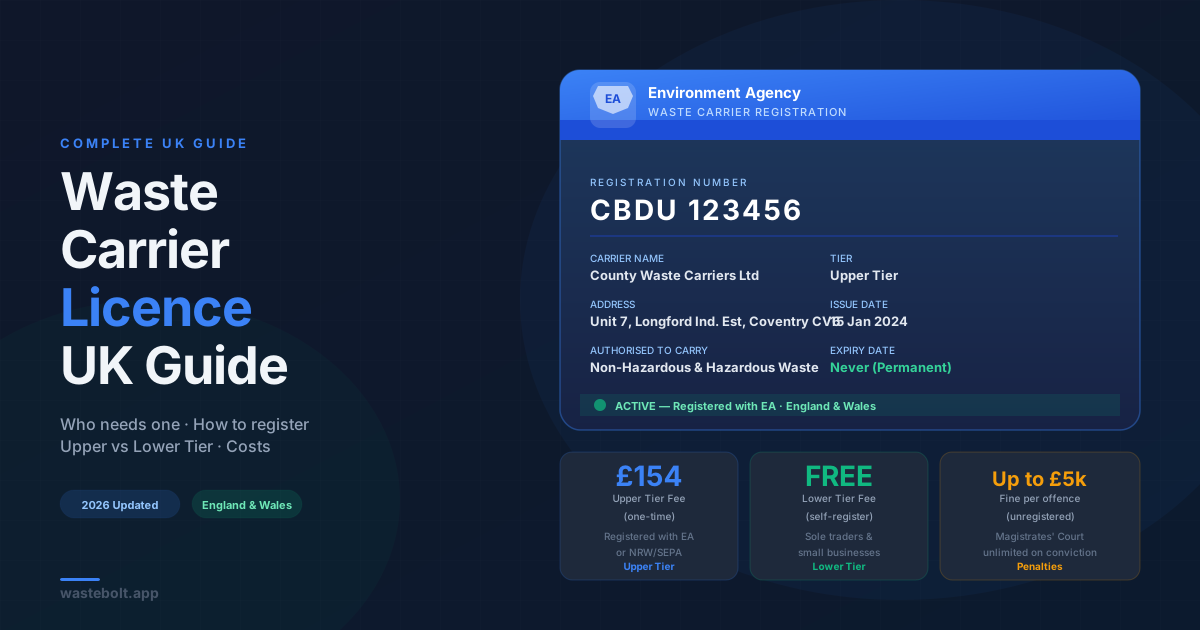
Your registration number (format: CBDU followed by six digits for upper tier, CBDL for lower tier in England) must be recorded on every Waste Transfer Note you are party to as the carrier.
England vs the rest of the UK: In Wales, registration is with Natural Resources Wales (NRW). In Scotland, it is with SEPA. In Northern Ireland, it is with NIEA. This guide primarily covers England and the EA process, but the structure is broadly similar across all four nations.
Who Needs a Waste Carrier Licence?
You need to be registered as a waste carrier if you carry, transport, or arrange the transport of controlled waste as part of your business. This includes:
- Skip hire companies — collecting skips from customers and delivering to a transfer station
- Waste collection contractors working for councils or businesses
- Builders and construction companies that collect waste from their own sites AND other sites
- Metal and scrap dealers who collect materials from third parties
- Garden waste and green waste collectors
- Hauliers who carry waste as a load (even occasionally)
- Waste brokers and dealers — those who arrange waste movements without physically carrying
- Facilities that receive waste from third parties and move it on-site (may need carrier registration for internal movements)
Exemptions: You do not need to be registered if you only carry waste you have produced yourself (e.g. a builder taking rubbish from their own building site to a tip in their own van). This is lower tier territory — but even then, a lower tier registration is still required by law.
Upper Tier vs Lower Tier: What Is the Difference?
There are two tiers of carrier registration. Which one you need depends entirely on whether you carry other people’s waste or only your own.
| Upper Tier | Lower Tier | |
|---|---|---|
| Who it covers | Anyone carrying waste produced by someone else (commercial carriers, skip hire, waste brokers) | Businesses transporting only their own waste |
| EA fit and proper check | Yes — EA checks for relevant convictions | No — self-declaration only |
| Registration fee | £154 (new) · £105 (renewal) | Free |
| Renewal | Every 3 years | Every 3 years |
| Registration number format | CBDU + 6 digits (England) | CBDL + 6 digits (England) |
| Can carry other people’s waste? | Yes | No |
| Required on Waste Transfer Notes? | Yes — carrier reg required | Yes — carrier reg required |
In practice: if you are a skip hire company, a waste haulier, or any business whose core activity involves transporting waste produced by others, you need upper tier registration. Lower tier is for a sole trader who occasionally takes their own workshop waste to a recycling centre.
Brokers and dealers also need to be registered, but under the “broker/dealer” category rather than carrier. If you arrange waste movements but don’t physically carry the waste, this is the correct registration type — the process and costs are the same as upper tier.
Registration Number Formats Across the UK
The registration number format differs by nation, even though the underlying tier system is the same everywhere:
| Nation | Regulator | Upper Tier Format | Lower Tier Format |
|---|---|---|---|
| England & Wales | EA / NRW | CBDU + 6 digits | CBDL + 6 digits |
| Scotland | SEPA | WCR/R/xxxxxxx | WCR/R/xxxxxxx |
| Northern Ireland | NIEA | ROC UT xxxx | ROC LT xxxx |
If you operate across borders, you need a valid registration in each nation you carry waste in — an English CBDU number does not cover a Scottish or Northern Irish collection.
How to Register as a Waste Carrier
Registration is done online via GOV.UK. The process for upper tier registration:
- Create or log in to your GOV.UK account. You will need a GOV.UK One Login account to access the waste carrier registration service.
- Complete the online application form. Provide your company name, registered address, Companies House number (if applicable), SIC code, contact details, and the types of waste you intend to carry.
- Declare convictions (upper tier only). You must declare any relevant convictions — waste offences, fraud, or environmental crimes — for the company and its key people. False declarations can result in prosecution.
- Pay the registration fee. Upper tier: £154 by card. Lower tier: free. Payment is made online during the application.
- EA review (upper tier only). The EA carries out a “fit and proper person” check. This typically takes 2–4 weeks. If no relevant convictions are found, registration is granted automatically.
- Receive your registration certificate. You will receive a certificate with your registration number (CBDU/CBDL format). Keep this safe — you will need the number for Waste Transfer Notes.
Already registered? Make sure your registration is still active. You can check the EA’s public register at GOV.UK. Registrations that have not been renewed will show as expired — and operating on an expired registration is the same as operating without one.
Costs and Renewals
Registration fees as of 2026:
| Tier | Cost | Note |
|---|---|---|
| Upper Tier (new) | £154 | Includes EA fit and proper person check |
| Upper Tier (renewal) | £105 | Every 3 years · payable online |
| Lower Tier | Free | New registration and renewal |
| Replacement certificate | £10 | Applies to both upper and lower tier |
Both upper and lower tier registrations must be renewed every three years. The EA will send a renewal reminder, but do not rely on this alone — track your renewal date yourself and set a calendar reminder 60 days before expiry.
There is no grace period for an expired registration. If your registration expires and you carry waste the next day, you are operating illegally — even if your renewal is in the post.
Waste Carrier Licence and Waste Transfer Notes
Your carrier registration number must appear on every Waste Transfer Note where you are listed as the carrier. This is a legal requirement under the Waste (England and Wales) Regulations 2011.
In practice, WTNs must include the carrier’s:
- Company name and address
- Carrier registration number (CBDU/CBDL format)
- Vehicle registration plate (where relevant)
- Driver name (if required by the receiving site)
A receiving site has a duty of care to check that the carrier collecting their waste is registered. They should verify your registration number on the EA’s public register before or when collecting the first load — and periodically thereafter. See our guide on how to write a Waste Transfer Note for a full section-by-section breakdown.
Hazardous Waste Carriers
If you transport hazardous waste, you need an upper tier registration — lower tier does not cover hazardous material under any circumstances, regardless of whether you produced it yourself.
The documentation requirement is also different: instead of a standard Waste Transfer Note, hazardous waste movements require a Hazardous Waste Consignment Note, which includes HP codes and, where applicable, POPs (Persistent Organic Pollutants) declarations. The receiving site must also hold a permit that specifically covers the hazardous waste type you are delivering. Read more about hazardous waste consignment notes →
Waste Carrier Licence and Digital Waste Tracking (DWT) 2026
From October 2026, Digital Waste Tracking becomes mandatory for all permitted waste receiving sites across England and Wales, with Scotland and Northern Ireland following from January 2027. Your carrier registration number will be a required field in DWT submissions — exactly as it currently is on paper Waste Transfer Notes — so an expired or invalid registration will block a digital submission just as it would invalidate a paper WTN today.
WasteBolt stores your carrier registration number and includes it automatically on every WTN and DWT submission, so there’s nothing to re-enter as sites move over to digital tracking. See our Digital Waste Tracking Software page for details.
Operating Without a Waste Carrier Licence
Carrying controlled waste without being registered is an offence under Section 1 of the Control of Pollution (Amendment) Act 1989. Penalties:
| Enforcement route | Detail |
|---|---|
| Fixed penalty notice (FPN) | The EA can issue an FPN of up to £300 without going to court. Often used for first-time minor offences. |
| Magistrates Court | Fine of up to £5,000 per offence. Can also include a vehicle seizure order — the EA can physically seize and forfeit vehicles used to carry unregistered waste. |
| Crown Court | Unlimited fine on conviction on indictment. Custodial sentences are possible for serious or repeat offending. |
| Permit implications | If you hold an environmental permit for a facility, an unregistered carrying offence may be treated as a permit breach — potentially leading to permit revocation. |
The EA carries out roadside checks and can stop vehicles transporting waste to verify carrier registration on the spot. If your driver cannot produce proof of registration, the EA has the legal power to seize the vehicle.
Frequently Asked Questions
Do I need a waste carrier licence to transport my own business waste?
If you are transporting waste that your own business has produced, you only need to register as a lower tier carrier — which is free and straightforward. You do not need an upper tier registration. However, if you are transporting waste produced by someone else (even occasionally), you need an upper tier registration.
How long does it take to get a waste carrier licence?
Lower tier registration is usually processed within a few working days online. Upper tier registration takes longer — typically 2–4 weeks — because the EA carries out a fit and proper person check on the applicant. If there are issues with the application, it can take longer.
Does a waste carrier licence expire?
Upper tier registrations must be renewed every three years at a cost of £105. Lower tier registrations are also renewed every three years but at no charge. Both registrations expire if not renewed, so it is important to track your renewal date.
Can I check whether a carrier is registered?
Yes. You can search the EA’s public register of waste carriers, brokers, and dealers at the GOV.UK public register. This shows the carrier’s name, registration number, type (upper or lower tier), and status (active or revoked).
What is the fine for carrying waste without a licence?
Carrying controlled waste without a valid registration is an offence under the Environmental Protection Act 1990. The maximum penalty on summary conviction is £5,000. On conviction on indictment, the penalty is unlimited. Courts can also impose a custodial sentence and order confiscation of vehicles.
Do I need a separate licence for Scotland, Wales, or Northern Ireland?
England and Wales share a register administered by the EA and NRW respectively. Scotland is administered by SEPA and Northern Ireland by NIEA. You need a registration in each country where you plan to carry waste. An English registration does not cover Scottish operations, for example.
Can I carry waste before my registration is confirmed?
No. You must have a confirmed registration before carrying controlled waste. Operating without a registration while an application is pending is still an offence, even if you have already applied and paid the fee.
Do I need a separate licence for each vehicle?
No. One upper tier registration covers your entire business and all vehicles you operate under that business name — there is no per-vehicle fee or certificate.
What’s Next
- How to Write a Waste Transfer Note — a step-by-step guide with a worked example
- Digital Waste Transfer Notes — what they are and how to create one
- Digital Waste Tracking Software — WasteBolt’s DWT-ready platform, listed on GOV.UK